Author: Michael

  • Web Literacy 101: Look Up!

    I have a geeky habit that I would like to admit…I prefer to type out web addresses, rather than bookmarking them.

    Why? Because it forces me to think about how websites are organized, and it tunes me into the browser address bar and what site I’m at. I completely understand that using the search box to find a site can be more efficient, but the concern I have is that clicking on search results, without noticing the actual web address, leads to misunderstanding how sites are organized. It is a basic skill that can greatly improve basic web literacy.

    Take for example three sites used regularly by our district: the public web page, our school intranet (WITS), and our new Google Docs accounts. If you do not know the web address for one of these, obviously a search is in order. After visiting each of the sites, by looking up, you notice the web addresses of the three sites are:

    • www.williamsvillek12.org
    • wits.williamsvillek12.org
    • googledocs.williamsvillek12.org

    It becomes obvious that the overall domain is williamsvillek12.org (also know as the second-level and top-level domains), and within there are multiple sub-domains (also know as third-level domains). If you are looking for the Williamsville wiki site for a particular teacher or group, you will find web addresses including these:

    • www.wiki.williamsvillek12.org
    • hmedtech.wiki.williamsvillek12.org
    • “nameoftecher”.wiki.williamsvillek12.org

    Once again, the overall name remains williamsvillek12.org, while the sub-parts change. In the case of Williamsville wikis, all share the same third, second and top level domains (***.wiki.williamsvillek12.org). It is only the very beginning of the address that changes.

    This analysis can be applied to any web address, and should be the first step in web literacy for students – what is the URL of the site you are at? What is the top-level domain (.edu, .com, .org, etc.)? By reading the URL, can you determine any information about the site? Every time you click, keep your eye on the browser’s address bar – one click can take you somewhere you do not expect.

    Let’s take it one step further to look more closely at our district Google Docs accounts – the web address is below. When you click on it, keep your eye on the address bar (the link is set to open in a new tab or window).

    When you click on the link and go to the site, notice that the address changes to something much longer and crazier:

    • https://www.google.com/a/williamsvillek12.org/ServiceLogin?service=writely&passive=1209600&continue=https://docs.google.com/a/williamsvillek12.org/&followup=https://docs.google.com/a/williamsvillek12.org/&ltmpl=homepage

    That is a very different web address, but stick to the base address – www.google.com. We have a district Google Docs account with a district web address, but the actual accounts are on Google’s servers, not servers owned/managed by the district. There are many more interesting pieces about that web address that are more geeky and I will leave out, except for one (can’t resist…) – buried in the web address is “service=writely.” Before Google Docs was created, there was an online word processor called Writely that really got the ball rolling in terms of writing and collaborating online. Google purchased Writely’s company in 2006 and merged it with its Google Spreadsheets application. Even though Writely went away years ago, it still lives in the web address for Google Docs (and is the technology behind Google Docs).

    OK, sorry to geek out there, but I think you get the point. Web addresses are extremely informative. There is no need to know the ins and outs of every web address, but the basics can really shed light on the world wide web for students. All you have to do is look up!


    Image licensed from iStockphoto.com

  • One Pipe

    I have been tinkering around with my Google Voice account after a colleague, @MrWarnes, showed me what he was trying with it. Then, speaking with our assistant principal, we got to talking about how tools like Google Voice and Skype are making traditional land lines obsolete. Wouldn’t it be great if everything you need for communication and productivity in school were in one place, one pipe if you will, coming through the ethernet cable?

    Five years ago we cut the extra “pipes” into our house. We canceled our land line and switched to a VOIP phone service. All of our communication has been going through our cable modem. Some of our friends still find it “shocking” that although we have internet access through the cable TV provider, we don’t subscribe to cable TV. This is only due to the sticker shock of paying for so many channels that we never watch. Additionally, with the onslaught of Internet video services (Hulu, etc.), I believe the days of over-priced, over-stuffed channel services are numbered. In the last couple of months, fiber-optic service has been introduced in our area. We have signed up to convert to the higher quality dedicated pipe.

    Of course it is possible to have one pipe for all communications, and there are many companies that are capitalizing on making the computer the single point of communication. How might this look in a school setting for a teacher, an administrator, or better yet, a student?

    What would a main office look like if a principal (and his/her secretary) could manage all incoming and outgoing communication through the computer? What if a parent were able to go to the school website and click on a link to automatically call the school? What if the principal had an alert set up for any time the school hashtag was mentioned in Twitter, and could quickly respond if necessary?

    What would a teacher’s classroom look like if all of their communication could be handled through the computer? No more leaving the desk or classroom to make a call, and then having to wait to get back to the computer to find necessary information. Voice calling access for teachers on their computer would be a huge benefit.

    What would a student’s learning world look like if they had some form, any form, of technology at their disposal in the classroom? The technology divide for learning between adults and students is growing so large it is scary. We have arrived at a point where as adults and professionals, we could not last a day without the technology that we need. What sort of disservice are we doing by not providing our students with the same opportunity?

    Mobile phones, and smart phones specifically, are the alternate form of the one pipe scenario. Just as the data machine is adopting voice on the computer, the voice machine is adopting data on the mobile phone. Adults are more used to the computer version of one pipe, while kids are more used to the mobile version. The type of pipe does not matter – what matters is having access to the pipe for learning.

    Each of us needs only one pipe to be connected to the world. Each of us needs a pipe. All day, every day.

    Thoughts or comments most welcome here, through Google Voice, or through Skype:

    Skype Meâ„¢!

    Talk to you on the pipe!

  • Do You Want Me To Make That Harder For You?

    This week I’d like to share with you a personal screen-play about the power of technology, creativity, and children…

    • Cast: Father and son (yes, me and mine)
    • Setting: family room on a weekend afternoon
    • Props: couch, iPad, desktop computer

    Background: Remember the cool wooden maze game, Labyrinth? It is a wooden box with knobs on the side, and the goal is to guide the steel ball through the maze without falling into the holes. I have many memories of playing this game. Fast forward to 2010 – I have downloaded Labrynth 2 HD for the iPad. There are virtually limitless mazes to solve, new materials, bumpers, cannons, etc. My son is hooked on it. Following is a re-telling of what my son discovered:

    Father: (on couch, playing Labyrinth 2 HD on iPad) Drat…got blown up by a cannon again…

    Son: Daddy, click on the Create button on the screen.

    Father: OK – let’s check it out…there is a “New” button – it looks like you can make your own levels.

    Son: (squeals) Really?! Let’s do it!

    Father: The directions say to go to a website, enter the code for the software, and design levels on the computer.

    Son: (leaps to the computer) – I’m at the website – what is the code? (enters code) (investigates for a few moments while figuring out design interface) (squeals again) Awesome!

    [2-3 minutes pass]

    Son: OK dad, try out my level! (leaps back onto couch)

    Father: (opens level created by son) Is this the one you just had on the screen on the desktop computer?

    Son: Yes!

    Father: Sweet! (finishes newly created level quickly)

    Son: (leaps back to computer) Hold on – I know what I have to change! (brief pause) OK try it now! (leaps back to couch)

    Father: (reloads level, son is eagerly hovering overhead, watching intently) Oooo – tricky, but I think I can do this – thanks for putting this wall here.

    Son: I think I need to add some cannons and a few holes here…(leaps back to computer)

    Father: Got it!

    Son: Reload it and try again! (leaps back to couch)

    Father: (reloads level) Grrr…hmph…grrr…almost…rats. (tries again multiple times) Whew, got it finally!

    Son: Do you want me to make that harder for you?

    The above scenario is one that has played out countless times in my house. There is a magic mix of design, creativity, physics, and immediate feedback that is spectacular. The physical manipulation of the game on the iPad (Labyrinth is on the iPod Touch also), combined with the ability to design levels and immediately try them out creates a hyper-motivating environment which my son (and now my daughter) loves to work in. One aspect we have not begun yet is to create and share levels with other people, but I’m sure we will get into that before too long. While the original analog version of Labyrinth is still fun, it cannot compare to where the current version has gone, thanks to technological connections.

    There are many thoughts and ideas triggered for me when I think about this scenario, but on my mind right now is this: The students entering our schools are familiar with and live in these environments. There is content they have to learn that is most likely not familiar to them at all. What are we doing to help our students learn in ways that will immerse them and motivate them?

    To use a concept from David Perkins book, Making Learning Whole, what are we doing to help kids “play the whole game?”

  • Glogging NYSCATE 2010

    NYSCATE 2010 has begun in Rochester. I am going to try a different approach to posting snippets of my experiences (rather than a stream of tweets). Here is a Glog of workshops, ideas, blurbs, etc. that are coming out of NYSCATE. I’m putting this up on Saturday afternoon, and will hopefully add as the conference goes on…

    Sunday night update – learned quite a bit about Glogster, including the need to save often in case your finicky wireless internet connection goes kapoof while working…

    Monday night update – what a thought-provoking, enriching day. IMHO, Heidi Hayes Jacobs hit it out of the park with her passionate, intensely motivating keynote. Would need a thousand glogs to capture all her ideas…

    Tuesday night update – NYSCATE delivered another great conference. Will need time to unpack it all, but I really did like glogging. There is definitely an artistic feel to putting together a glog – I’m going to put this one to rest for a while, but am very interested to revisit it, use it for talking points and reflect on what I thought was most important.

    Happy Thanksgiving!

    Roll your mouse over the Glogster banner for the option to view full size.

  • Three Great Conferences and Change in the Air

    This week is shaping up to be very adult-learner centered. I’ll jump to the end of the week when next Saturday begins NYSCATE’s Annual Conference in Rochester, NY. NYSCATE always puts together a great program that combines visionary leaders, enriching presentations and hands-on training. This year the program looks to do that again.

    What has my attention, though, are two virtual conferences happening earlier this week, though. On Wednesday November 17th, Tech & Learning is orgainizng Virtual Tech Forum. This is an online version of the popular Tech Forums that have appeared around the country for almost a decade. The lineup for the virtual event includes Chris Lehman, Howie DiBlasi, David Jakes, David Warlick and many more. The event is free (sponsored by Tech & Learning, of course), and all you have to do is register on their site.

    Hmmm…top experts presenting online…no need to travel…much less expensive (as in free)…makes you start to wonder about f2f conferences…which brings me to the other virtual conference this week…

    Running all week (Nov. 15-19) is the Global Education Conference, organized by Steve Hargadon and Lucy Gray. This conference casts a wide and impressive net about making learning global. Keynote speakers (63 of them!) are from well respected global groups such as iEARN and ePals, among many others. As of today, there are 397 sessions over the 5 days. All of the Global Education Conference is taking place free, online, using Elluminate (Elluminate being the sponsor).

    Hmmm…free…online…conferences. What does this mean for the expensive (but still worthwhile) face-to-face conferences? It makes it harder to justify the time and money involved when there is starting to be a wide array of such events just a few keystrokes away. If we are in fact trying to promote global connection with technology, then it seems to make good sense that we gather that way also. Virtual events are by no means free – there are still speakers to be paid (maybe), bandwith to support (definitely), but their value to a wider audience is certainly excellent.

    Change is in the air for how conferences will happen in the future…

  • Where the People Are

    Image Licensed from iStockphoto.com

    I really disliked Twitter when it first came out. I looked at it and thought I had no desire to know when someone ate a sandwich or went to the bathroom (still don’t). I did not like the fact that thoughts or ideas had to be stunted to 140 characters (still don’t). It struck me as a craze that will go by the wayside when the next tool comes along (5 years into it, Twitter may have sticking power, but who knows?).

    However, Twitter does have one key benefit. People. It is where smart people post ideas, thoughts and conversation starters. Skimming a Twitter feed of can generate lots of great reading and ideas. Like any successful tool or service, it relies on the community of users to make it valuable.

    I am new to the Twitter game, but I get it now. I am amazed at those who can be posting on Twitter constantly (or so it appears). I have made it my goal to try to post one idea, reflection or thought per day to contribute to the stream. I have tried one or two conversations and lurked in the #edchat discussions, but have not actively jumped in (time is the big issue here). I have added Twitter into my routine, but have not given anything else up. Actually, that is not true – I do much less focused reading on one thing (like a book), and more fly-by browsing. Not sure if that is good, though.

    Just like managing email is best kept to one or two short time periods per day, I think Twitter is best like this, or else it may take over.

    Here is what I wish for future versions of Twitter (or whatever service becomes the “in” tool):

    • The ability to type more than 140 characters. I understand that brevity is key, but some leeway would be nice.
    • The ability to manage information without need for a 3rd party app (TweetDeck, HootSuite, etc.). If you provide a service, why not provide the ability to use it??? The #NewTwitter interface is definitely an improvement.

    There are other services that do provide a broader range of communication tools, starting with “status updates” and the ability to grow into more in-depth conversations. At the national level, LearnCentral is one such community. Steve Hargadon’s efforts in bringing an incredible amount of people to the discussion table in LearnCentral is remarkable. All of LearnCentral is “free,” with the understanding it is a service sponsored by Elluminate.

    At the state level, NYSCATE’s Ning community is another such service. Nings have been around for a number of years, and recently made news when the free versions were going away, causing a stir in the ed tech community (my thoughts on free tools can be found here). Regardless, NYSCATE has adopted the Ning format, and within the community are many layers of ways to communicate and collaborate. LearnCentral and NYSCATE’s Ning don’t have the power of people as much as Twitter does, but the scalability of conversation in these networks is much greater.

    So, do I Tweet? Yes. And I will continue to? Yes, and perhaps a bit more. As a matter of fact, as soon as I put up this post, I’m heading over to Tweet about it. However I want more than 140 characters as an option for expression (hmmm…maybe that’s one of the reasons for this blog…).

    Learning requires community, and communities are only strong if they have people in them. Twitter is one such community, but there has to be more.

    P.S. Please do not ask me about Facebook!

  • A Zillion Ways to Use Technology in the Classroom

    I am a big fan of new technologies for the classroom. I am not a big fan of taking a new technology tool and coming up with ways to use it for learning. As much as I am a fan of mechanical tools, I do not dream up 1000 ways to use a screwdriver. When the job is at hand, and I know that a screwdriver fits the bill, I use it.

    So where is the correlation between mechanical tools and technology tools? When you have a screw loose (pun intended), it is easy to assess what the problem is and what the tool is. It is not so easy to do the same in learning. Teachers know what their students need in terms of learning, but they do not necessarily know what technology tool can help them. This is especially true of web 2.0 tools, since new ones come out fast & furious.

    The result? We get “*** (insert number) ways to use ****** (insert technology tool) in the classroom.” While this technique is meant to spark ideas and possibilities, I believe more often than not it promotes superficial investigation followed by a quickly fading interest and use. Technology tools are tools – definitely ones that have specific uses that may be new and unique – but are not one-size-fits-all. I am not saying that anyone intends them to be – just that the “*** ways to use” method promotes it.

    I struggle with ways to introduce new tools to staff, as there is only so much time and attention that can be given. If tools are presented in the context of the job they are intended to help with (a toolbox), then it is much easier for people to see the need, then the tool to help with the need.

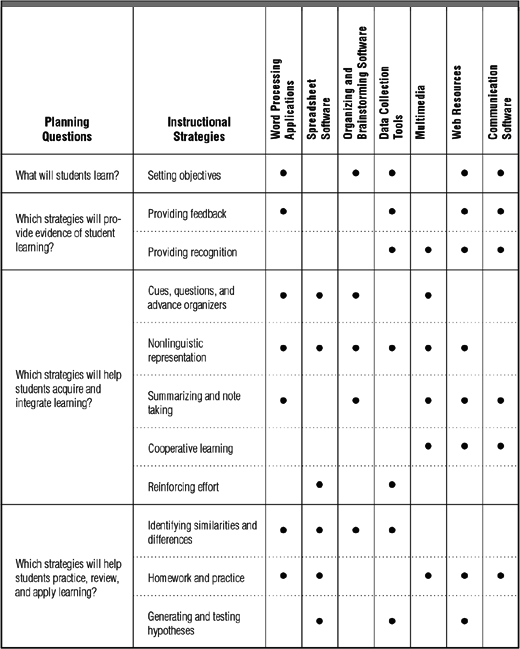
    The best toolbox I have seen is the one provided by MCREL in the book, Using Technology with Classroom Instruction that Works. In the book, the authors take Robert Marzano’s research-proven instructional strategies and then categorize software tools that support the strategies.

    Here is the graphic provided to illustrate the toolbox:

    Conversations that start with the toolbox have questions such as, “How can I help students identify similarities and differences with technology? Using the chart, it is readily apparent that word processing applications, spreadsheet software, organizing and brainstorming software and data collection tools can support this need.

    The next logical step is to analyze what specific tools withing those categories can help achieve the task. The book outlines many specific examples, but how can the need be addressed quickly, incorporating tools that may have come out since the book was written a few years back?

    One way is with a wiki created by Stehpanie Sandifer, titled Web 2.0 & Marzano’s CITW. This community-editable wiki provides a directory of web 2.0 tools that support each of the strategies. This format is very useful as it can be updated regularly. It does not appear that too many edits have happened recently, but it is a great model for a living, dynamic technology toolbox for teachers. I just joined the the wiki and am hoping to contribute to it.

    I’m going to keep looking, however, for a dynamic resource that allows the input of any technology tool, not just web 2.0 tools, withing the context of the CITW toolbox. There are many software packages out there that are not web 2.0 tools that can be included in the toolbox.

    For me personally, one resource I’m going to check out is a book talk on Using Technology with Classroom Instruction that Works, being hosted by ISTE’s Innovative Learning Technology Special Interest Group on their wiki.

    It is definitely much harder to analyze technology tools in this fashion, but at the end of the day, I believe it is much more worth it to have the need, followed by the toolbox, followed by the tool to do the job.

    Image citation:

    “Matrix.” Association for Supervision and Curriculum Development. 5 Nov. 2008
    <http://www.ascd.org/ASCD/images/publications/books/pitler2007_fig7.gif>.

  • Superman is Already Here

    Before you read this post, please take a moment to go on a field trip to do the following:

    Walk to the nearest mirror you can find, look at yourself in the eyes for about 30 seconds, then come back.

    Image licensed from iStockphoto.com

    Hello Superman, it’s nice to meet you. Please understand that I use Superman in the general sense, whether you are a man or a woman. Yes, you are Superman.

    I am offering this post to contribute to blogger Tom Whitby’s call for education reform ideas (he calls it REBELS – Reforms from Educational Bloggers Links of Educational Suggestions). In the past few weeks, there has been much discussion in the national spotlight about what we need to “fix” education. There was the special on MSNBC, Education Nation; the film Waiting for Superman; Oprah Winfrey’s show with David Guggenheim, Bill Gates and Michelle Rhee; and a FutureofEducation.com/Edutopia panel discussion in Elluminate that have contributed to the dialog.

    I listened to the FutureofEducation.com/Edutopia panel discussion and attended the Buffalo premiere of Waiting for Superman (which included a panel discussion with local educational leaders/politicians), and have been trying to keep up with the various posts and tweets flying around related to the issue.

    I will share some of my reactions to the Buffalo premiere of Waiting for Superman and the panel discussion, as it was a good opportunity to localize the national discussion.

    • The event was organized by BuffaloRefomEd, a fledgling group looking to improve the education system. Since they were able to bring together the Superintendent of the Buffalo schools, the president of the Buffalo Teachers union, the New York State assemblyman for Buffalo, among others, BuffaloReformEd appears to have its act together.
    • The audience was probably heavy on the charter school supportive side, not surprisingly as the tone of the movie is pro-charter schools.
    • Personally, I think the angle of the movie, with its fire-the-teachers, get-rid-of-tenure, unions-are-bad tone spent more time on attractive easy solutions that really are not solutions. No one wants bad teachers – but in the big picture, I think the amount of “bad” teachers is a minuscule amount, and they don’t make it in the long run. Are there problems in the system with some teachers? Sure, but that is true of any employer/employee organization.
    • Charter schools are a great choice. Are all charter schools great? No. Are some out-performing the public schools? You bet. One of the main points in the movie is that some charter schools are finally making a difference in performance scores for students on standardized tests. The real problem here is that the charter schools are measuring themselves on the very standardized tests that are the greater issue in education. I do not know if charter schools, who pride themselves on being different, should celebrate with the same measures that public schools use in order to prove their value.
    • In the panel discussion, the head of a local charter school made the statement (I’m paraphrasing):  The purpose of K-12 education is to prepare students for post-secondary education. Yikes – I’m not sure that is the purpose of K-12 schools. What happened to preparing students to become productive, contributing members of society? Not every path leads to post-secondary education.
    • At the end of the discussion (all too brief at only 30-40 minutes), the superintendent of Buffalo and the local assemblyman pledged to reconvene a panel for a longer discussion at a later time. Dialogue is always good, but…

    We don’t have time to talk about what needs to be done. Superman is here – it’s you, it’s me, and it’s every person who has direct influence on helping kids succeed. It is the parent, the neighbor, the teacher, the mailman, the uncle, the teacher, the principal, the union leader, the grocery clerk, etc. I know, this sounds a lot like the “it takes a community to raise a child” shtick, but it’s true.

    Every one of the students portrayed in the movie has a Superman. It is the parent/guardian, who all said they would do anything in the world to help their child. It does not matter what school they get in – those kids have a superman looking out for them.

    Charter schools have by their nature lots of Supermen. Those who choose to create their own system, their own school, take on a huge challenge. By their nature, those in charter schools are demonstrating superman qualities.

    Public schools are full of Supermen. Every single day, they take on the daily challenges of meeting the needs of the students in their class. The challenges are very different depending on where you live. I live and teach in an affluent suburban district. We have many challenges every day with every one of our students. The daily challenges we face are vastly different from the challenges faced by those in the urban schools. Still, every day we go in to do what we can for every single one of those we work with.

    We can have all the panel discussions we want. We can make all the movies we want. We can get the best thinkers and politicians in the world together to talk for hours, days, weeks or months. It won’t matter – that’s just talk.

    What will matter is the work you do with whatever kids you have a direct connection with. It might be your own kids, it might be the kids you teach, the kids you administer, or the kids on the block. What matters more is you may have to reach out and help kids you see who have a need, but no one to help them. You may have to intervene when kids you work with do not get what they need. Education reform is you, doing whatever you can, whenever you can, no matter what.

    No more time to read now, Superman, you have work to do. Important work.

  • A Look at Ray Kurzweil’s Education Predictions for 2009

    I’m reading Ray Kurzweil’s The Age of Spiritual Machines now, which was written in 1999. In the book, Kurzweil makes predictions for the future in 2009, 2019, 2029 and beyond. In the predictions chapter for 2009, there is a section on education. I’d like to try a little experiment and present the section from the chapter, edited to where we really were in 2009. The excerpt is from p. 791-792. My edits of the original text are either in strike-through or bold face.

    In the twentieth century, computers in schools were mostly on the trailing edge, with most effective learning from computers taking place in the home. Now in 2009, while schools are still not on the cutting edge, the profound importance of the computer as a knowledge tool is widely recognized. Computers play a central role in all facets of education except the classroom, as they do in other spheres of life.

    The majority of reading is done on displays paper, although the “installed base” of paper documents displays is still formidable beginning to appear. The generation of paper documents is beginning to dwindling dwindle, however, as the books and other papers of largely twentieth-century vintage are being rapidly scanned and stored passed over in favor of digital versions. Documents circa 2009 routinely include embedded moving images and sounds continue to be delivered on paper.

    Students of all ages typically do not have a computer of their own, which is a thin tablet-like device weighing under a pound with a very high resolution display suitable for reading. Students interact with their computers primarily by voice and by pointing with a device that looks like a pencil keyboard. Keyboards still exist, but most textual language is created by speaking. Keyboarding classes continue to be offered to help students input more efficiently. Learning materials are accessed through print, wired, and wireless communication.

    Intelligent courseware has emerged as a common means of learning. Virtual schools have appeared, replacing traditional schools. Recent controversial studies have shown that students can learn basic skills such as reading and math just as readily with interactive learning software as with human teachers, particularly when the ratio of students to human teachers is more than one to one. Although the studies have come under attack, most students and their parents have accepted this notion for years. There is controversy as to the effectiveness of virtual learning, but financial need is driving the growth of such offerings. The traditional mode of a human teacher instructing a group of children is still prevalent,  but schools are increasingly relying on investigating software approaches, leaving human teachers to attend primarily to issues of motivation, psychological well-being, and socialization. Many A few children learn to read on their own using their personal computers before entering grade school.

    Preschool and elementary school A select small group of children identified as low-level readers routinely read at their intellectual level using print-to-speech reading software until their reading level catches up. These print-to-speech reading systems display the full image of documents and can read the print aloud while highlighting what is being read. Synthetic voices sound fully somewhat human. Although some educators expressed concern in the early ’00 years that students would rely unduly on reading software, such systems have been readily accepted by children and their parents. The expense and logistics of reading systems have prevented their adoption for all students. Studies have shown that students improve their reading skills by being exposed to synchronized visual and auditory presentations of text.

    Learning at a distance (for example, lectures and seminars in which the participants are geographically scattered) is growing in use, but is by no means commonplace.

    Learning is becoming a significant portion of most jobs. Training and developing new skills is emerging as an ongoing responsibility in most careers, not just an occasional supplement, as the level of skill needed for meaningful employment soars even higher.

    In 2009, we were not anywhere near where Kurzweil predicted, although we are beginning to move in the directions he indicated. It feels like it takes forever to make progress that we need to make, but I do believe the change agents that will eventually spur the change are the ones indicated in his text. In two different examples, Kurzweil mentions that acceptance of a new technology is by students and parents, essentially forcing the school to change. I think that is exactly the type of force that is going to provide true change in the education system.

    The only paragraph that I did not make any edits to is the last one. That particular idea is timeless and apparent to most – adaptability in the workforce is the key to making it in the 21st century.

    If you would like to see the original excerpt without my edits – look up the book at Google Books – those pages (791-792) are available to view there.

    Maybe by 2019, we will realize some of the 2009 predictions. 🙂

  • Momentum

    This coming Friday, October 8th, our district will be holding a staff development day focuesd on technology. It is going to be an exciting day, as there are many events planned. A quick overview:

    • Keynote by the ever-inspiring Alan November
    • Content-area breakout session (focused on instruction that incorporates technology)
    • Elective breakout session (focused on a technology tool)
    • Student Showcase

    This is no small undertaking with a staff of over 1000 who will be in attendance. Figuring out how to effectively feed that many people is a job unto itself. District and school staff have been working countless hours for over a year to plan for this day. We have a few talented outside presenters coming in, but other than that, all presentations are begin done by our own staff.

    Why, you may wonder, would we…

    • Coordinate the movement of 1000 staff and 100 students for 7 hours between 2 buildings (that thankfully are on the same campus)?
    • Take a perfectly normal gymnasium and supply it with enough computers,  power, and networking for over 100 students in 25 different booths?
    • Install and reinstall software in computer labs to accommodate different technology tool sessions?
    • Ask expert teachers who are mostly used to working wtih 20-30 of their own students to share their expertise with 100-200 of their colleagues?
    • Ask students, who would otherwise have a day off, to come in and share how they use technology?
    • Ask our custodial and IT staff to essentially transform the 2 buildings to a conference format beginning at 2:00 the day before?
    • Make sure that every professional assignment, from core subjects to paraprofessionals, has a session devoted to technology which applies to them?
    • Offer technology tools sessions that span the gamut of available resources?

    The answer, in a word: momentum.

    We have a lot to gain by taking a day to show off what we have, what our own teachers and students do, and provide some insight into where we want to go.

    Here are a few more questions:

    • Will there be enough time to learn everything about a technology tool during this day? No – but there will be time to get one’s feet wet, and our professional development catalog has follow-up courses to support those interested.
    • Will teachers be exposed to current technology integration practices by their colleagues in other classrooms? You bet – that is the idea behind the content sessions.
    • Will new ideas and thought-provoking conversation be cultivated? Yes – Alan November is a master at this.
    • Will we celebrate what our students are doing? This may be one of the favorite parts of the day – our students will show off how they are using technology.

    A lot of great learning and sharing will take place on this day. I think the main spark of the day will be to cause great momentum in the use of technology in the classroom. It’s going to be a great day.

    Update 10/12/2010: I wrote this post a week prior to the event.  Since the day is now over, I have asked staff to comment with their reflections.

    Image licensed from iStockphoto.com