Author: Michael

  • Thank You Heim Middle

    As I finish up this week at Heim Middle and get ready to begin my new position at district office, I wholeheartedly say thank you to all of the great people at Heim. It is hard to believe that I have been here nine years – wow did the time fly! Part of the reason for this is my children – those of you at Heim long enough have been part of their birth and growth. It seems like just yesterday when Adam and Anna visited as infants, and later came dressed up as a lion and tiger for Halloween when they were four and three. Now they just finished second grade and kindergarten, and it just gets faster.
    I start by talking about my family because I consider myself incredibly fortunate, and proud, to say I am part of the Heim family. It is said often that Heim is a special place, and that is because it is. As you know, when you run into a Heim alum, they immediately start reminiscing about a memory here. A comment made many times that sticks out in my mind is when someone is asked to describe Heim in one word. Without hesitation the reply is “family.” Absolutely true. The members of the family change regularly, but like relatives, the Heim family has a special connection no matter where in the world they are.

    We have made great progress in technology in the last nine years. When I first arrived, I remember that the number one task was to make sure there was an iMac (blueberry to be specific) in each classroom so teachers could do email. Jump to this year when teachers offer up a menu of technology choices for students to pick from for their projects. There are many reasons for the progress we have made, and the most significant one is the desire and willingness by the faculty to try new things and help each other out. We could never have done many of the things we did without many of you stepping up and sharing your expertise with your colleagues. Additionally, I attribute much of the progress in recent years to the district focus on incorporating technology. Major projects such as placing the projectors in every classroom could not happen without major district-wide direction.

    Speaking of district-wide direction, that leads me to the topic of the new structure for the technology integrators next year. While it is true the middle schools will have less access to this resource than they have had in the past, the elementary and high schools will have more access, which is a good thing. I can tell you that the technology integrators team for next year is dynamite, and I know you will enjoy working with them when you have the opportunity. I hope that the new model of district technology integrators will lead to creating more such positions in the future.

    As for me, I am thrilled to be taking on my new role as Instructional Specialist for Fine and Performing Arts, Business Education and Home and Careers (my son loves saying that). I know it is a surprise to some of you who did not know my background is music. Some people have said I am going back to my “roots.” Personally, I just think I’m still trying to figure out what I want to do when I grow up. Maybe I’ll figure it out someday.

    In any case, this is my way of trying to express how special a place Heim will always be to me.

    Thank you Heim Middle. You have made me a better person. I am forever grateful for it.

  • New Technology Integrator Position

    As part of the reorganization of the district for next year, the building-based middle school technology facilitators are going to become district-based technology integration specialists. It will be a similar role to what was going on in one building, but in the new design, the integrators will be able to help teachers across the district. If I had not moved into my new job as an Instructional Specialist, I would have been one of these technology integrators. On the job posting are “typical work activities,” which I have listed below. In between are my comments on what I think each means.

    Technology Integrator Typical Work Activities

    1. Assumes leadership responsibilities in district- and building-based efforts to design and implement consistent technology integration strategies to increase the probability of improved student achievement.

    • I think the key to this is consistency across the district and within buildings. It is very hard to link technology use to improved student achievement, but consistent, targeted efforts to use technology really should help.

    2. Meets with Instructional Specialists and building administrators to determine curricular focus, need, and implementation of pertinent technology integration strategies.

    • This is one of the strongest benefits of the new job structure. The ability to plan with district and building administration will be key to rolling out technology. As an Instructional Specialist, I am already planning ways in which I would like to use the Integrators, and get my colleagues to capitalize on them as well. 🙂

    3. Assumes leadership responsibilities in organizing, assessing, designing and implementing appropriate training activities to assist faculty in infusing technology to support the curriculum.

    • This is the “meat” of the job. Setting up and delivering training to staff is the main and most important job. There will be less direct contact with students, but much more during-the-day and after-school training.

    4. Understands and supports technology components of the emerging NYS Reform Agenda.

    • The New York State Teaching Standards, approved in January of this year by the Board of Regents, clearly spells how how technology is an integral part of instruction. I highlighted these performance indicators in a recent post (found here). Whether you love it or hate it, the daily professional life of teachers is going to change significantly due to the Race To The Top initiative that New York is a part of.

    5. Assists in the development, implementation, and monitoring of the District Technology Plan.

    • Like all districts, we have a three year technology plan that drives the overall direction for technology. It only makes sense that the Integrators are a player in it.

    6. Stays on top of current trends and research in technology integration, and assists faculty in becoming familiar with new and emerging technologies to solve problems and improve job performance.

    • This is actually one of the most fun things to do – keep up with the geeky stuff and show it off! At the same time, it is important to not get caught up in the latest thing just because it is “cool.”

    7. Participates in district, BOCES, or other appropriate training to build knowledge and skills.

    • Going along with number 6, this is important in order to be able to keep up.

    8. Maintains a staff relationship and meets regularly with building Technology Facilitators to discuss hardware, software, and training support for technology integration strategies.

    • Since the Technology Integrators are now totally separate from the Technology Facilitators, this is an important connection to the buildings. Each Integrator will be responsible for working with three or four buildings. I think the Technology Integrators should make it a point to be at building Technology Committee meetings each month at their buildings to maintain the lines of communication.

    9. Attends District Technology Committee meetings.

    • This is an easy one, and very informative. The District Technology Committee oversees the District Technology Plan, so this is an obvious connection (see number 5).

    10. Coordinates with the Instructional Specialist for Professional Development, the Assistant Superintendent for Technology Services, and the Assistant Superintendent for Instruction to assist in planning for district-wide professional development activities which support technology integration.

    • Once again, this is key to rolling out technology integration. Similar to what has gone on recently in the district, including last October’s Staff Development Day for Technology, the Technology Integrators will be very involved in district initiatives.

    11. Works collaboratively to assess and report student technology literacy.

    • One of the challenges the middle school technology facilitators have faced each year is how to assess and report 8th grade technology literacy, as it is a required reporting item for New York State. On one hand, it is easy to report “skills,” but on the other hand it is difficult to measure “literacy.” This will always continue to be an interesting discussion.

    12. Collaborates with the Assistive Technology Team, as needed, to support students with learning needs, to implement recommended tools/devices, and assist faculty to apply universal design principles when selecting technology integration strategies for lessons.

    • We have a model Assistive Technology Team in the district who do an amazing job. In this new role, the ability to work with them more is a very exciting proposition.

    ~~~

    The job description is quite detailed, and as far as I can determine, right on. Technology integration revolves around keeping up with what is going on, providing training, monitoring progress, and always staying focused on improving learning for students and staff. This is an exciting position and I am very excited for the people who are going to have these positions!

  • Moving On

    I am delighted to report that the work to get my administration certificates has paid off. This past week I was appointed to an administrative position within my district, Williamsville. Effective July 1st, I will be the Instructional Specialist for Fine and Performing Arts, Business Education, and Home and Careers. That is a long and complex sounding way to say I am the  curriculum and instruction coordinator for Music, Art, Business, and Home & Careers.

    For anyone reading some of my recent posts, you may have noticed a distinct focus on what is going on in the New York State Education Department (NYSED). One of my main responsibilities in the new position will be to keep up with what is going on at NYSED, and how it will affect the teachers and curriculum in the areas I am responsible for. As I have been going through the interview process, I became much more in-tune with the happenings in Albany, and therefore posted more about that. One could easily devote a full-time job to keeping up with NYSED 🙂

    As I move into the position, one of the things on my mind is how this blog will work into my new role. I will absolutely keep it going, but I wonder what focus the blog should take on.  I started blogging in 2004 after hearing David Thornburg speak at an ISTE conference. Back then “blog” and “wiki” were relatively new terms, and being a technology integrator, it has been a perfect fit for me. I have grown through and enjoyed the writing I do.

    I also wonder if the title and tag line is appropriate in my new position. Here is what is at the top of the blog:

    Point A to Point B
    Technology is transforming learning. All you need is an idea of where you are and where you need to go.

    The title of the blog, Point A to Point B, and the web address (which I own) I think are appropriate for any educational endeavor. Regardless of the content, everyone is at point a, and is trying to get to point b.

    Regarding the tag line, technology is certainly transforming learning in every area including the ones I will be responsible for. As a matter of fact it was music technology that was the catalyst for me making the jump to becoming a technology integrator in the first place! Many staff and students I have worked with in recent years are surprised when they learn that music is my background.

    I have come around to where, like many, I know it is not about the technology, it is about the learning. So how about this for a tag line (it is actually my Twitter tag line right now):

    Point A to Point B
    Learning is job #1

    I do not think one could argue learning is our fundamental purpose. My writing will focus more on the content areas I’m involved with. I will still probably draw out connections to technology, but I am actually really liking the fact that I can focus on technology from a content perspective instead of technology as a separate “thing” (which I admit I can do quite easily…). At the end of the day, it is about the learning (in Music, Art, Business, and Home & Careers, etc.) and not about the technology.

    I would love your thoughts on what I have outlined here. If you have any comments or suggestions for the tag line, I would appreciate that also. My “point a” is changing, as is my “point b”, and I’m looking forward to the journey!

    Image courtesy of woodleywonderworks on Flickr

  • Fast and Furious – Keeping Up with Changes at NYSED

    The New York State Education Department (NYSED), like many other states educational agencies, is undergoing massive restructuring due to the Race to the Top (RTTT) funding initiative. There are many arguments to be made about whether the RTTT program is worth it or just another national political toy. It does not matter which side one falls on – the reality is that there are many changes that are coming down to New York schools beginning this fall.

    The amount of information, and the resulting changes, are coming out incredibly fast from NYSED. Law passed last year require NYSED to implement many new programs this fall, including the Common Core State Standards (CCSS), and a new evaluation program for teachers and principals. As I have been trying to maintain a handle on what is going on, my personal recommendation for those trying to get their heads around what is going on in NYSED boils down to 2 items:

    1. Take approximately 2 hours to watch the presentation, “Bringing the Common Core to Life,” by David Coleman, a chief architect of the Common Core State Standards.
    2. Read the news updates from NYSED Race to the Top page. You can subscribe to the news updates via a listserv or RSS feed if you like.

    Two hours to watch a presentation? Yes that is a long time to recommend you take, but it is worth it. David Coleman is a key player in the CCSS. He is a compelling speaker, and when you listen to him, he really does bring the standards to life. He gives examples of what the CCSS will do differently and better. He takes time to provide one specific example in ELA (Martin Luther King’s Letter from the Birmingham Jail) and and one in Mathematics (6th grade fractions). He then extrapolates those specific examples to demonstrate how the CCSS promote deeper learning on less topics, which is a different direction than current New York State Standards.

    What watching his presentation has done for me is provide a framework for understanding the CCSS, and how they complement, and then improve on, what we already do. He acknowledges that New York does great work already, but that by shifting the focus, and depth, we can do better. He very eloquently describes how all subjects (Science, History, Technical Subjects the Arts, etc.) play a key role in the CCSS. His presentation is very motivational in investigating the CCSS more deeply.

    The news updates that come from the NYSED RTTT page are an easy way to keep up with decisions and issues the State is dealing with right now. For example, a memo from John King, Senior Deputy Commissioner for P-12 Education, was released last week. In it he includes the updated time line for implementation of the CCSS, and asks for model lessons from teachers, with guidelines for submission that are correlated to the new standards. Reading this memo alone, and the accompanying documents, shed a lot of light on where the State is at in terms of the RTTT implementation. The time line for implementation is aggressive. NYSED appears to be pushing for all teachers to introduce CCSS lessons next year, and not just grade 4-8 teachers of ELA and Mathematics.

    As I read the news updates, I find it prompting me to keep up with what is going on with the state education governing body, the Board of Regents. Each month, the Board meets for 2 days to govern education policy. Each meeting covers an incredible amount of topics with far reaching scope. The meeting this month on May 16th and 17th deal with multiple topics related to the RTTT initiative (also known as the Regents Reform Agenda) and consideration for revising graduation requirements for high school students.

    It is hard to feel the impact of actions at NYSED and the Board of Regents in day-to-day work, but what is going on now at the state level is going to be felt directly by everyone in the very near future.


  • Cogito Ergo Blog

    I reflect, therefore I blog.

    A tweet came through last week that caught my attention. I retweeted it, favorited it, and now have spent some time looking back, reading, reflecting, and now writing:

    As is the case with social media, the path to the origin of the thinking took a bit. Shelly Terrell sent this tweet about a post by Justin Martin on the Connected Pricipals blog. Justin’s post was in response to the “ground zero” post by Ryan Bretag, “My Principal Doen’t Need to Blog.” Ryan’s original post is brilliant – he uses not too many words to propose an argument that blogging is not worth it for his principal (who is an exceptional leader). What Ryan unleashes is an awesome response across the spectrum related to administrators and the value/need/time in blogging (including my response here…)

    The thought about “to blog or not to blog” hits home with any blogger since we constantly wonder, “is it worth it?” As I read through the original post, comments, and subsequent posts, here are a few things that stood out to me.

    In Ryan’s argument, he makes the following comment:

    In life, we make trades of our time and the question really comes down to whether blogging would be a better use of time for our principal than…

    1. Visiting classrooms
    2. Getting to know and connect with 2,100 learners
    3. Getting to know and connect with hundreds of educators

    In my first administration experience as summer school assistant principal, I made a conscious effort to be out and about as much as possible. My daily social media connections definitely went down (not logging into Twitter, Skype, etc). I completely agree that the most important job of an administrator is personal connections.

    One of the responses to Ryan was from Russ Goerend:

    For me, blogging is where I reflect with the purpose of asking other, smarter, people to reflect with me. Reflection is the one thing I saw missing from your list of what your administrator does. Is that a possible reason that tips the scales?

    Reflection is the bell-ringer for me in blogging. I think reflection in teaching practice is important. Any good teacher or administrator reflects, whether in voice (chatting with a colleague) or in public (a blog). The difference between vocal reflection and written reflection is that writing it down makes a difference. To paraphrase Peter Reynolds, writing turns ideas into action. Writing it down in public makes a bigger difference. Is written public reflection on practice for everyone? Nope. Can it make a difference in the practice of a teacher or administrator? IMHO, yup.

    Before I move on to more of my own thoughts, I want to point out one more comment that came through on this topic. It is a video post by David Truss:

    I love the media response, as opposed to a typed response. His thoughtful comments, along with visual support, is awesome. Thanks, David, for providing an exemplar for media communication. I hope to move that direction in my own blogging – I think it is much richer 🙂

    To bring together my own thoughts about why I blog, I took a look at the wikipedia article for blog. Under the sub-heading for types of blogs, here is the description for a personal blog:

    Personal blogs
    The personal blog, an ongoing diary or commentary by an individual, is the traditional, most common blog. Personal bloggers usually take pride in their blog posts, even if their blog is never read. Blogs often become more than a way to just communicate; they become a way to reflect on life, or works of art. Blogging can have a sentimental quality. Few personal blogs rise to fame and the mainstream, but some personal blogs quickly garner an extensive following. One type of personal blog, referred to as a microblog, is extremely detailed and seeks to capture a moment in time. Some sites, such as Twitter, allow bloggers to share thoughts and feelings instantaneously with friends and family, and are much faster than emailing or writing.

    I bolded the part that stands out to me most – blogging become more than a way to communicate – it is a way to reflect. The comment about bloggers taking pride in their work, regardless of readership, also rings true. I have always blogged for an audience of one (me), although it is fun when people stop in to read and/or comment.

    Blogging takes time. My personal goal is to try to do one post per weekend, when the idea comes to me. Note that it happens on the weekend, and that there are the time trade-offs that allow me to find those few (3-4) hours to craft my thoughts. I have found that I do enjoy the writing process. Not everyone does, and not everyone has the time to devote to blogging. Ryan’s principal doesn’t, but he is still a great leader. If his principal does try blogging (and makes the trade-offs to do so), I believe he will find it valuable. I do not believe that anyone who takes the time to do it will find it un-worthwhile.

    In any case, for me, cogito ergo blog. Thanks for taking the time to read this.

  • Collaboration, Coaching and Reflection

    Professional development is a key component in helping students learn. When teachers are focused on improving student learning, they need support (i.e. professional development) for themselves to continue to learn. Some of the most inspiring colleagues I have worked with are those who, even after a long career, continue to seek out opportunities to improve their craft. Experienced and successful educators acknowledge that there is always something new to learn, a new technique, or new concept that will help kids.

    Collaboration, coaching and reflection are not new concepts. What they are, however, are new ways to approach professional development to improve learning in a systematic way. I will use the analogy of my past experience as a band director to draw connections to how teachers have always coached, collaborated and reflected, and compare that to how we can make systemic change.

    From the beginning of time, musicians would perform a concert, and then go out to celebrate (or commiserate) afterward on the performance. This is true of concert musicians as well as music teachers after a school concert. What typically happens in the “after-hours” celebration is a lively dialogue among teachers involved in the concert and colleagues who attended the concert. Discussion ensues about what went well, what could go better, and steps to take for next time. It is a dynamic, fluid process of collaboration, coaching and reflection that moves teachers forward. Next steps that might happen is that a particular teacher might go to visit a colleague to see how he/she works with their students to solve a similar challenge. A guest clinician might be brought to school to coach teachers on rehearsal techniques. Teachers may get together after school for a few weeks in a row to teach each other about instrument intricacies. These types of experiences are informal, and occur spontaneously after a performance. How can we formalize this process so it benefits every teacher, every day, but does not water-down the effectiveness?

    The same exact scenario above can be played out by any teacher in any discipline immediately following a major benchmark assessment or other summative assessment, such as a state exam. Math teachers, for example, will have a spirited dialogue about an exam as it is being administered, analyzing the strengths and weaknesses they suspect among their students and how they perceive students will perform. This continues as the results are reported and strategies are investigated to help students succeed.

    How are more recent professional development models in-line with the collaboration, coaching and reflection needs of staff? With the data team as a fundamental unit now, the model is in place for regular and routine dialogue along these lines. At its core the data team is a formalized way for colleagues to collaborate on how students are performing, and identify strengths and needs for students. During this process they might decide that assistance is needed with a particular instructional strategy or technology so a coach is called upon. In my role as technology facilitator I consider myself the “technology coach” for whomever needs assistance. Throughout the data team process, reflection is built-in as well as teachers think about their students’ performance and their own teaching.

    As an aside, with the NYS Race To The Top initiative, one of the key components of the new structures being created is called the school-based inquiry team. NYSED defines the inquiry team as:

    School-based Inquiry Teams – comprised of teachers, teacher leaders and administrators – are charged with becoming expert in accessing, understanding and using data to identify a change in instructional practice (e.g. teaching division of fractions) that will accelerate learning for a specific group of underperforming students. Based on what is learned from that experience, teams work with school staff to implement and monitor system-level change to benefit all students. The reflective practice that is used as the basis for the Inquiry Team’s work is intended to support continual, evidence-based improvement of student learning. While each school is to have at least one Inquiry Team, more teams may be put in place should the school find it valuable to do so.

    Click here to see NYSED document with this definition.

    To me this refers to the data teams we already have in place. While there are many individual teams and no one overriding data team to analyze system-level change for the whole school, the purpose of our data teams is in line with the definition of the inquiry team above. It appears we are well positioned as components of the RTTT initiatives are rolled out in the coming years.

    Image licensed from iStockphoto.com

    While it is not as relaxed as an after-concert celebration, the more formalized process of collaboration, coaching and reflection built into our data teams and the coming RTTT initiatives put us in an excellent position to help our students excel.

  • Staff Development Day March 2011

    On Friday the district held a staff development day where we split up by curriculum area K-12. The focus for the day was on design questions from Robert Marzano’s The Art & Science of Teaching. Facilitators for each curriculum area were formed into what were called design teams, and included content teachers, administrators, and a technology facilitator. I was the technology facilitator for the Health and IDEAS team.

    In our district, health education at the elementary level is done through the IDEAS program. The IDEAS teachers are gifted and talented certified teachers who provide level one gifted programming services to every student in the school. Elementary students have IDEAS class once every five days from kindergarten through fourth grade. At the middle school level, students have health class for 20 weeks in eighth grade. At the high school level, students can take the required 20 week class during any year.

    One of the biggest successes is that it was first time all the health teachers K-12 had the opportunity to work together for a full day! Just the fact that they could have professional dialogue with all level colleagues was awesome. They really enjoyed the time to work and share together.

    One of the biggest challenges health teachers have is that many times the content they teach is about things students should not do (tobacco, alcohol, etc.) and true assessment can be difficult. While a student can have all the knowledge about why smoking is bad and get a good grade on a health test, it is whether or not they choose to smoke when outside of school that is the true reflection of their skills. One form of feedback we discussed is the Search Institute Survey administered every other year by the Town of Amherst in partnership with district schools. It is an anonymous survey given to 8th, 10th and 12th grade students about their supports and behaviors related to the 40 Developmental Assets. Results for the Town of Amherst (not just the Williamsville district) can be found on the Town website. Individual schools have results for their buildings.

    We spent part of the morning defining and refining learning goals and had work time for each level (elementary, middle and high) to have dialogue on topics of their choosing. We also allowed time for working with technology tools of their choice. All of the documents we shared went through district Google Docs accounts in a shared folder. We used Prezi for the main presentation points during the day (see presentation embedded above), and also show examples from Xtranormal and Animoto.

    I have the good fortune to see the health curriculum through not only this dialogue day, but also through our district curriculum council. The health teachers presented their overall curriculum recently, and to me there are two overriding themes to all the units health teachers do:

    • goal setting
    • decision making

    These themes are found throughout every unit, at every level. Whether it is an elementary student thinking about food choices, or a high school student thinking about relationships, these themes are essential to those conversations.

    Part of the afternoon was spent focusing on providing effective feedback. As many health teachers are also coaches, we used the coaching analogy to talk about how effective feedback in the classroom should be like effective feedback on the playing field.

    I have to say for me this was one of the most stressful days to prepare for personally since I was not that familiar with the health curriculum or the teachers involved. That being said, it is not the role of any one person to be the expert at everything. This day was about collegial dialogue, where everyone has something to contribute. The other facilitators I worked with were awesome. We had many meetings where we discussed and planned how the day should go. Once the staff development day got rolling and we were working together, it was great. Overall I think it  went very well. Feedback indicated that participants were happy, and they provided ideas on how we will structure the next day we are together, which is scheduled to be at the end of August. I feel much more comfortable about the next time we are together now that we have some momentum!

    I’ll finish with a great Animoto video created by Tricia DeSantis (Assistant Principal at East HS) on learning goals – note the awesome soundtrack!

  • Technology Integration in the New NYS Teaching Standards

    New York is a winner of the Race to the Top funding initiative sponsored by the federal government. There is a whole host of passionate conversation about what RTTT means for education. I’m going to skip that part of the dialogue for now and focus on what has been going on in New York, and specifically on what has already happened at the state level and the implications for the very near future.

    For the past 2 years during the state’s involvement in applying for and winning a RTTT grant, the Board of Regents has actively been implementing parts of what it calls the Regents Reform Agenda (RRA) (sorry for the multiple acronyms – it’s easier to type). The RRA is essentially the plan in place to carry out the items specified in the RTTT application.

    One of the components of the RTTT application is an updated performance review process for teachers and administrators. New York had to change its application, which was rejected in the first round, to reflect a more concrete process in which to demonstrate an updated review process. In May of 2010 new law was passed by the legislature – section 103 of the laws of 2010 specifically addresses teacher and principal performance review. The new section of the education law, 3012-c, can be found here.

    The law indicates that teachers and principals must be evaluated on a combination of student performance (40%) and personal performance (60%). Regarding the 60% based on personal performance, the law states, “The remaining percent of the evaluations, ratings and effectiveness scores shall be locally developed, consistent with the standards prescribed in the regulations of the commissioner, through negotiations conducted pursuant to article fourteen of the civil service law.” (Section 3012-c(2)(h))

    The standards prescribed in the regulations of the commissioner (as mentioned in the law) were just approved by the Board of Regents at the January 2011 meeting. They come in the form of the New York State Teaching Standards. There are seven standards, with underlying elements and performance indicators, that outline the skills necessary for teachers. These standards were designed so rubrics for performance could be developed. The work group putting together the teaching standards stopped short of developing specific rubrics, as there are other groups working on that right now. For a list of FAQs surrounding the development of the standards, click here: Teaching Standards Q&A

    Here is the full document with the newly adopted NYS Teaching Standards: New York State Teaching Standards

    So in the age of technology and its use in the classroom, where does New York State stand in terms of what teachers should be doing with technology? One of the questions from the Q&A document provides some light:

    Q. Is there a separate standard for a teacher’s use of technology?
    A. The ability of educators to use a variety of technological tools, techniques, and  skills to inform and enhance teaching, learning, and other aspects of  professional performance is crucial to their effectiveness in today’s learning environment.  Since technology is such a prevalent factor in today’s world and is included in so many aspects of teaching and student learning, a decision was made to infuse technology throughout all of the Standards rather than to isolate it in a single Standard.  Therefore, references to the use of technological resources, knowledge, and skills are found throughout the Teaching Standards ( e.g. Elements I.6;  II.6;  III.4;  III.5; etc. ).

    Technology, or technologies, is referenced 11 times within the standards – below are the specific references. Take a look and see what you think. Please note that I am only showing any mention of technology. Some of the items items are elements within standards, and some are performance indicators within elements.

    • Teachers demonstrate knowledge and understanding of technological and information literacy and how they affect student learning.
    • Teachers use technological tools and a variety of communication strategies to engage each student.
    • Teachers incorporate a knowledge and understanding of technology in their lessons to enhance student learning.
    • Teachers explore and use a variety of instructional approaches, resources, and technologies to meet diverse learning needs, engage students, and promote achievement.
    • Teachers incorporate instructional approaches and technologies to provide students with opportunities to demonstrate mastery of learning outcomes.
    • Teachers engage students in the development of multidisciplinary skills, such as communication, collaboration, critical thinking, and use of technology.
    • Students utilize technologies and resources to solve real world problems.
    • Teachers organize and utilize available resources (e.g., physical space, time, people, technology) to create a safe and productive learning environment.
    • Teachers ensure that all students have equitable access to available resources and technologies.
    • Teachers use multiple measures and multiple formats, including available technology, to assess and document student performance.
    • Teachers advocate, model, and manage safe, legal, and ethical use of information and technology, including respect for intellectual property and the appropriate documentation of sources.

    I like the fact that technology is not a separate standard, as it needs to be used as a tool. I like the fact that ethical use is specifically mentioned. I like the statement, “students utilize technologies and resources to solve real-world problems.” As a matter of fact, I think every statement included in the standards related to technology is excellent.

    I wonder how this is going to play out. Since the annual professional performance review (APPR) is a locally-negotiated item, how will these standards come into play when the review document is created? According to the state, there are a number of pilots underway right now to test various types of rubrics to support the standards. As with any measure of professional performance, the meat and value of the review will come with the details of how the measurement is done.

    The new New York State Teaching Standards represents a top-down model for improving teaching and learning, motivated by the Race to the Top initiative. We are going to spend a lot of time transforming current systems to this new model – I hope it’s worth the time and effort.

  • There’s an App for That

    We just received 4 iPads to use in the building. My initial thought is to put them in the library since that is one place that all students have easy access to, and would get them the most exposure. In order to maximize the potential for their use, we are going to start with a “study” where we get feedback from teachers and students on the best apps/uses for the iPads.

    I’ll get the ball rolling by taking a few minutes to look back to the posts I did last year regarding the iPad:

    Now that it a little over 6 months since I wrote those posts, what apps have I come to rely on the most on my iPad? Here are my top three:

    • Safari – No big surprise here that the main task I do is use the Internet. Many times while working at a website, I will learn that there is an app for the website (for example, The Buffalo News has a news app). I then download the app, and depending on its usefulness, may begin to use the app instead.
    • Mail – Managing and responding to email on the iPad is very easy.
    • Angry Birds – if you have not been bitten by the Angry Birds bug, be warned – it is a game that will suck you in quickly! If I ever happen to forget to bring my iPad home, my kids are very upset if they do not get their Angry Birds fix (we have even ordered the Angry Birds stuffed animals…we’re completely hooked).

    Clearly the iPad has become my productivity/entertainment center – there are a whole host of apps that I use on a regular (but not every day) basis for a variety of things. In the hands of my kids, it is very interesting that they often choose some of the creativity apps and YouTube videos (that we watch with them) in addition to games.

    Which brings me to the task at hand – what apps should we be installing on the iPads for school? Some of the general categories are:

    • eReaders (iBooks, Nook, etc.)
    • Content area apps
    • Voice recording apps (the iPad has a built in microphone)

    I’ve put together a wiki page for staff and students to collect our thoughts on what apps to install on the iPads. I’m looking forward to how this rolls out.

    Just a footnote that I want to bring out here – we have 4 iPads for 650 students. The iPad is a highly personal device (I can attest to that). As we share the device, I keep thinking about a comment Brian Smith from Monroe 1 BOCES made recently:

    I still contend that these won’t be successful until they are made personal.  Meaning, give it to the kid to have for the entire year.  Let them take it home, play with it, read on it, correspond on it and make their learning personal.

    I’m currently in a pilot with iPads and the students are lukewarm to the device because they know it will go away or that they won’t be able to make it work for them personally.

    ~Brian C. Smith (@briancsmith)

    We are not at the point where everyone has one, but I think keeping in mind Brian’s comments make sense as we get going on getting the iPads out.

    Looking forward to some awesome learning!

    Creative Commons licensed image, iPad 3G and iPad Wi-Fi, by Yutaka Tustano on Flickr

  • Farewell, Friend

    This post is a tribute to a fantastic educator and colleague, Earle Holt. Earle is retiring from Heim Middle School after a 43 year career. His last day is December 23, 2010.

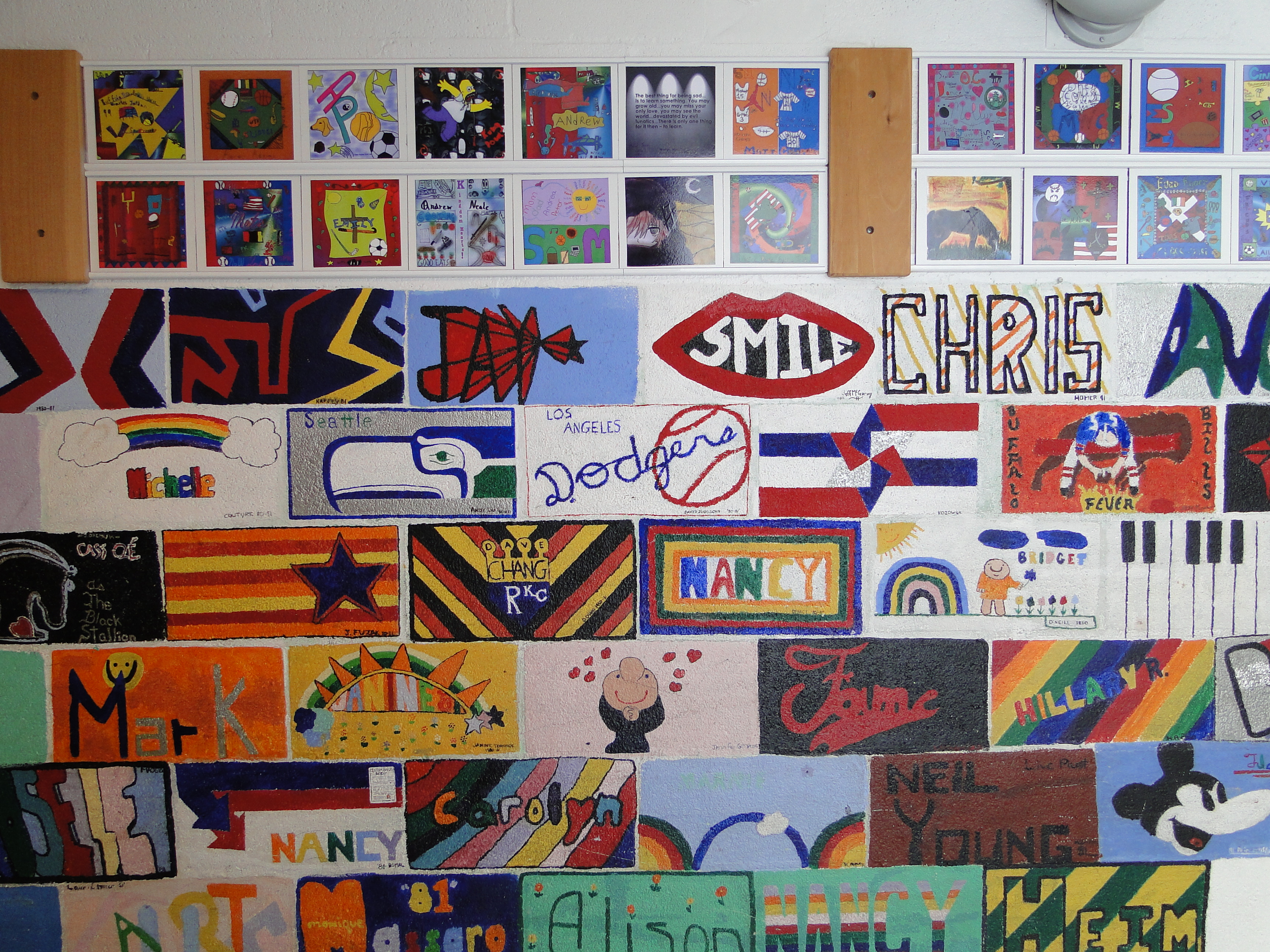
    Earle has touched so many lives in so many ways. Most importantly, as an art teacher he has had a great impact on thousands of students who have come through our school. One hallmark of Earle’s work is the wall block, and more recently, wall tile. Every 7th grade student for the last 43 years has created a personal reflection of themselves or something important to them, and either painted it on the wall or created it on the computer and had it mounted on the wall.

    If you walk through Heim Middle, in every hallway you see something like this:

    Click image to enlarge

    There are over 12,500 individual pieces of art, all created by students. There are many instances where parents and their children have shared the same experience creating a wall block/wall tile while they attended Heim. On any given day you might find an adult scanning the walls to find their work of art from years ago.

    I first worked with Earle when I arrived at Heim to help solve a problem – no more room to paint on the walls. We came up with a plan (actually he had the plan and I just helped get the technical kinks worked out) to have students draw their design, scan it, and finish creating it using paint software. The printed design is heat laminated to tile, then mounted on the wall (closer to the ceiling, above the painted wall blocks). The transition from painted wall blocks to scanned/printed/laminated wall tile was fascinating, and a great success.

    More than this particular project, though, is working with and observing Earle when he works with students. He has such a nurturing and warm style, and he truly cares about each and every one of the students. I have worked with him in his classroom regularly over the years. Recently in light of his retirement, I’ve tried to pay a few extra visits. His classroom environment is quite remarkable.

    His “corner of the world” has also been known as the place to get a cup of coffee, tea, and tasty treat whenever a break is needed. You always leave his room with a smile or a laugh. His warm, welcoming style reverberates with staff and students alike.

    I put together a brief slide show below as a tribute to a great person. Earle will be missed, but he deserves all the best that retirement has to offer.

    Farewell, friend. The coffee is on…

    Music by Kevin MacLeod
    Direct link to YouTube video