Month: August 2007

  • 10 Most Powerful Women in IT

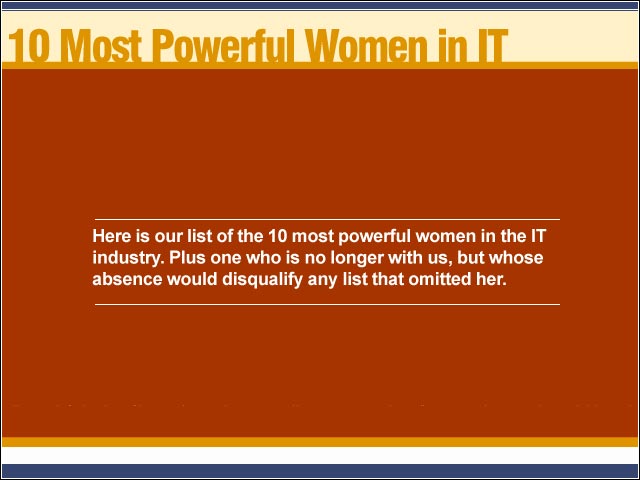
    Following in the series of article on leaders in IT (see my previous post, The 100 Most Influential *People* in IT) eWeek just released the 10 Most Powerful Women in IT. While I continue to struggle with the genderizing of the technology world (in other words, it’s only an issue if we make it one), I do believe we have to make sure we help girls realize that technology related fields are not just “for the boys.”
    10powerfulwomen.jpg

    Browsing this list, there are women in high places in some pretty powerful companies. This is what I think our girls need to see – bright, public, female leaders helping to shape our technology world. The one that jumps out at me is the person in the #1 spot – Diane Greene, CEO of VMware. VM stands for virtual machines – a technology that is just starting to come into play, and will likely transform our everyday computing experience in the next 10-15 years. Its great to see a female leader in an arena that is up & coming.

    Girls – remember – you are bright, capable, and have the absolute ability to change and shape the world – do not forget it!!!

    Citation:

    "10 Most Powerful Women in IT." EWeek. 31 Aug. 2007 <http://www.eweek.com/slideshow_viewer/
         0,1205,l=&s=26744&a=214069&po=1,00.asp?p=y>.
  • What Makes a Web Site “2.0”

    So “Web 2.0” is the term for the second generation of web sites. What exactly are the characteristics of a site that make it 2.0?

    Sites that are “Web 2.0” typically include most of the following:worldwide_web_network_cables.jpg

    • publishing (writing, pictures, videos…)
    • networking (link and group with other users on the site)
    • tagging (keywording)
    • RSS feed (for others to be able to subscribe to your site)

    If you take this blog as an example, it has 3 of the 4 listed – publishing, tagging and RSS. Blogs are the hallmark of Web 2.0. You’ll find that many sites now qualify for the new generation. In the old web, pages were there to read. In the new web, pages are there to to contribute to.

    Image citation:
    “Worldwide Web Network Cables.” Online image. PowerMediaPlus.com. 14 July 2007.

  • The Machine is Us/ing Us

    This video, created by Michael Wesch and posted at YouTube, is great to show how Web 2.0 has changed our world. The one here is a repost of the video at TeacherTube, a much more educational friendly site. It is not clear if this repost is has permission granted to do so, however.

    I’ve been trying to embed video here on the blog with mixed results – if your browser crashes, my apologies – still trying to learn how to do this fun stuff.

    Update 7 Sept. 2007: I’m pretty sure the emebedded video has been crashing this page, so to see the video, click here to view it at TeacherTube.

    Video citation:
    The Machine Is Us/ing Us. Dir. Michael Wesch. 2006. TeacherTube. 20 Aug. 2007 . This repost by mrstacey on Teachertube – original by Michael Wesch posted at YouTube

  • The Rules

    Following up on the previous post about what matters, where does technology fit in? Schools are about people and learning, regardless of technology. That being said, obviously technology plays a huge role in where we are going, so how do we keep on the best path? Its very easy to get sucked in by technology that is cool, or a time-filler, but has no real value. So here are 2 easy, basic rules for harnessing the power of educational technology:

    1. Does the use of technology create new and/or unique learning experiences not possible without the technology?
    2. Does the use of technology exponentially increase the efficiency and/or value of a process that is possible without the technology?

    If the answer to both is no, then its not worth devoting time to use the technology.

    Learning to Crawl

    Image citation:
    Lutz, R. Frank. “Learning to Crawl.” Flickr. 7 Aug. 2007 <http://flickr.com/
    photos/lf-photodesign/337715955/>.

  • What Matters

    As I form the foundation of the work for the new school year, what crystallized for me during the 3 day Bea McGarvey workshop on What Works in Schools, continues to be what I posted about last November:

    A school is people learning. (click on the sentence to go to the original post – still holds true).

    I’m excited about the District taking the Marzano research as the foundation of working, as it will give us common languageDictionary Definition: Learn to improve. As my thinking firms up even more, the work going on at Fablevision and Generation Yes continue to peak my interest. I do not yet see a vision for how they play in, but I think that will become clear when the time is right.

    Image citation:
    “Dictionary Definition: Learn.” Online image. PowerMediaPlus.com. 10 August 2007. <http://www.powermediaplus.com>

  • What Works in Schools

    I just finished a 3 day workshop sponsored by the school on the research of Robert Marzano and Debra Pickering. The workshop was lead by another of the Marzano group, Bea McGarvey. Bea is an entertaining speaker and shared many insights on the current state of education, and what we could/should do, based on research, to improve what we do.

    I think the most important aspect of this workshop is that it will provide everyone in the district with a common framework and language of research-based methods for improving learning. Much of what is in the research is stuff we do, but the research also indicates there are many things we should change or can do better.

    teamwork

    There were so many things covered, but here are my top “take-aways” from this week (not necessarily in priority order – just listing things that jumped out):

    • Just as doctors are experts on the human body, mechanics are experts on engine systems and pilots are experts on aerodynamics, teachers need to be experts on learning.
    • We spent quite a lot of time on on the systems of learning, including a model of the systems. I found a connection to the backdrop of learning which included the habits of mind, something I studied via the work of Art Costa.
    • The basis for Marzano’s work is, 1. Students Learn in Different Ways, and 2. Students Learn in Different Time Frames. Pretty straight forward, but Bea purposely put this slide up repeatedly, because if those are the foundationsal principles for learning, then we need to do some things differently.
    • We spent a lot of time on various pieces of the 11 factors that infludence learning (from the perspective of the school, teacher, and student). This research represents the breadth of work that Marzano undertook since his time at MCREL.
    • There are 9 proven strategies that influence learning positiviely: identifying similarities and differences, summarizing and note taking, reinforcing effort and provdiding recognition, homework and practice, nonlinquisitc perpresentations, cooperative learning, setting objective and providing feedback, generating and testing hypothesis, and cues, questions and advance organiziers. We spent time looking at a few of these.
    • Regardless of the strategy used, the goal is learning.

    The primary take-aways for me were the reaffirmation of 2 things (which I will post on separately soon…):

    1. We all own all kids in the school (that is, kids come first, and we all have to help every one of them in any way possible).
    2. Learning is why we are here.

    Reynolds, Peter H. “Teamwork.” Fablevision. 4 Aug. 2007 http://www.fablevision.com/education/clipart/index.html
    FableVision artwork on this web site copyright by Peter Reynolds/FableVision